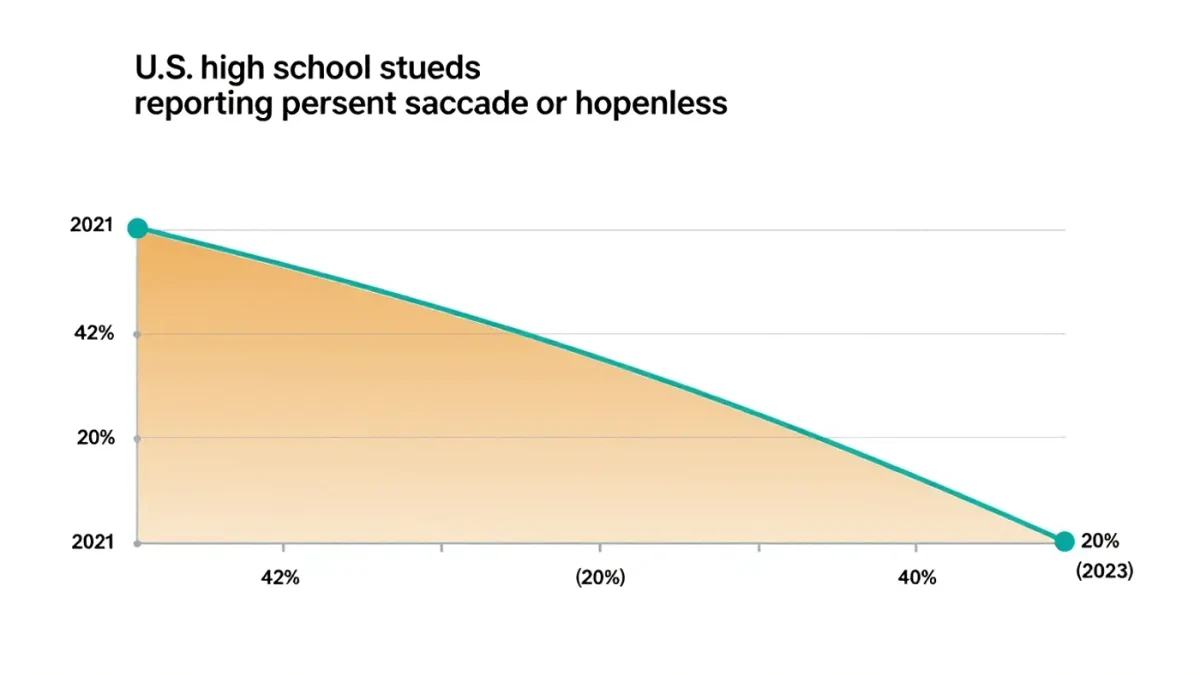
The latest federal data says two things at once about student mental health: the crisis has leveled off, and the school services built in response are losing their funding. Per the CDC's Youth Risk Behavior Survey, 40 percent of high school students reported persistent feelings of sadness or hopelessness in 2023, down from 42 percent in 2021 but still far above the roughly 30 percent of a decade earlier, and 20 percent said they had seriously considered attempting suicide. Schools became the main delivery point for youth mental health support over the same years — and much of that capacity was paid for with federal relief money that ended in 2024.
What does the CDC data actually show?
The 2023 Youth Risk Behavior Survey, released in 2024, was the first in a decade to show broad improvement: persistent sadness fell from 42 percent in 2021 to 40 percent in 2023, per the CDC, and several measures of suicidal thinking improved slightly for some groups. Two honest readings matter for families. The trend is real but small — the level remains well above the early 2010s baseline, which is why researchers describe it as a plateau at a high level, not a recovery. And the averages hide sharp gaps: female students and LGBTQ+ students report substantially higher rates of sadness and suicidal thinking than the national average, per the CDC's trends report.
Why did schools become mental health providers?
Because that is where the students are. Pediatric mental health capacity in clinics was already stretched before 2020, and families face long waits and insurance barriers outside school walls. During the relief-funding era, districts hired counselors and school psychologists, contracted with telehealth providers, and built screening and referral systems using federal ESSER dollars. The challenge is durability: those funds had to be obligated by September 30, 2024, and positions created with one-time money now depend on local budgets keeping them.
What services can a family actually ask for?
Most districts layer several supports, and parents can request each in writing.
- School counselor or psychologist referral. Every public school has access to counseling staff, though ratios vary widely; asking about wait time for a first meeting is fair.
- School-based or telehealth therapy. Many districts contract with providers who see students during the school day, usually with guardian consent.
- Screening and check-ins. Some schools run universal wellness screenings; parents can ask what exists and how results reach families.
- Formal support plans. When mental health affects attendance or grades, a student may qualify for attendance coordination or a plan under Section 504 — a route many families never hear about until they ask.
- Crisis resources. The 988 Suicide and Crisis Lifeline handles calls and texts for young people and their families, nationwide, at any hour.
How do families raise it without stigma?
Frame it as a support question, not a diagnosis. A parent can email a counselor with observable facts — sleep, grades dropping, withdrawal from friends — and ask what supports the school offers, rather than leading with a label. School staff respond better to specifics than to alarm, and the conversation creates a record that helps if the situation worsens later. For teens themselves, having a trusted adult at school identified by name is one of the strongest practical protections a family can arrange.
What should families watch in the next year?
The funding question. Districts that kept counselor and psychologist positions after relief funds expired did so with local money, and school board budget season — typically spring — is when those positions survive or disappear. Families who value school mental health staff can say so in budget hearings; boards weigh public comment heavily on close calls. The data trend gives grounds for measured hope, and the service capacity question decides whether that hope has somewhere to land.
What role does school connectedness play?
One of the sturdiest findings in the CDC's youth survey work is that school connectedness — feeling close to people at school, feeling part of the school — tracks with better mental health and fewer risky behaviors among high school students. The finding matters for families because connectedness is buildable in ways a diagnosis is not: a club, a team, a job at the school store, one adult who knows the student's name. When a student resists talking about feelings but would join a robotics team, the club is the mental health intervention, and it is one a family can arrange directly with the school.
What signs mean a family should act now?
The line between a hard stretch and something needing professional help is worth naming plainly. Sustained changes — weeks of disrupted sleep, withdrawal from friends and activities previously enjoyed, sliding grades, talk of hopelessness or being a burden, giving away possessions — warrant a professional evaluation, not more waiting. Immediate danger signs, including talk of a specific plan or means, mean same-day contact with a crisis line or emergency services. Pediatricians are a practical first door: they screen adolescents routinely, can rule out medical contributors, and hold referral lists with shorter waits than cold-calling a clinic. School counselors can run the school-side supports in parallel, and the two communicating — with the family's consent — is the arrangement most likely to hold.
How do families talk about it without making it worse?
Ask directly, and tolerate the first shrug. Questions like how are you actually doing lately work better than are you okay, because they signal that a real answer is wanted. Listening without immediately fixing is the parent skill researchers and clinicians consistently emphasize, and naming the situation honestly — a lot of students are having a hard time right now, you would not be the odd one out — lowers the stakes of admitting it. Keep the phone charged with 988 saved, keep the pediatrician's number current, and revisit the conversation every few weeks rather than treating one good talk as the resolution. That steady, low-drama checking-in is what the hopeful parts of the 2023 data actually look like in a kitchen.