Free community college is now real in a growing number of states: since Tennessee launched the first statewide promise program in 2014, more than a dozen states have created tuition-free pathways, and in 2024 Massachusetts became the first to make community college free for all residents without a bachelor's degree when Governor Maura Healey signed MassEducate in July 2024. What 'free' means in practice depends on the state — most programs are last-dollar scholarships that pay whatever tuition and fees remain after other aid, which is why reading the fine print matters more than the headline.
Juvenile Pre & Post publishes information, not financial advice; eligibility rules differ by state and program and change with legislative budgets.
Which states cover community college tuition now?
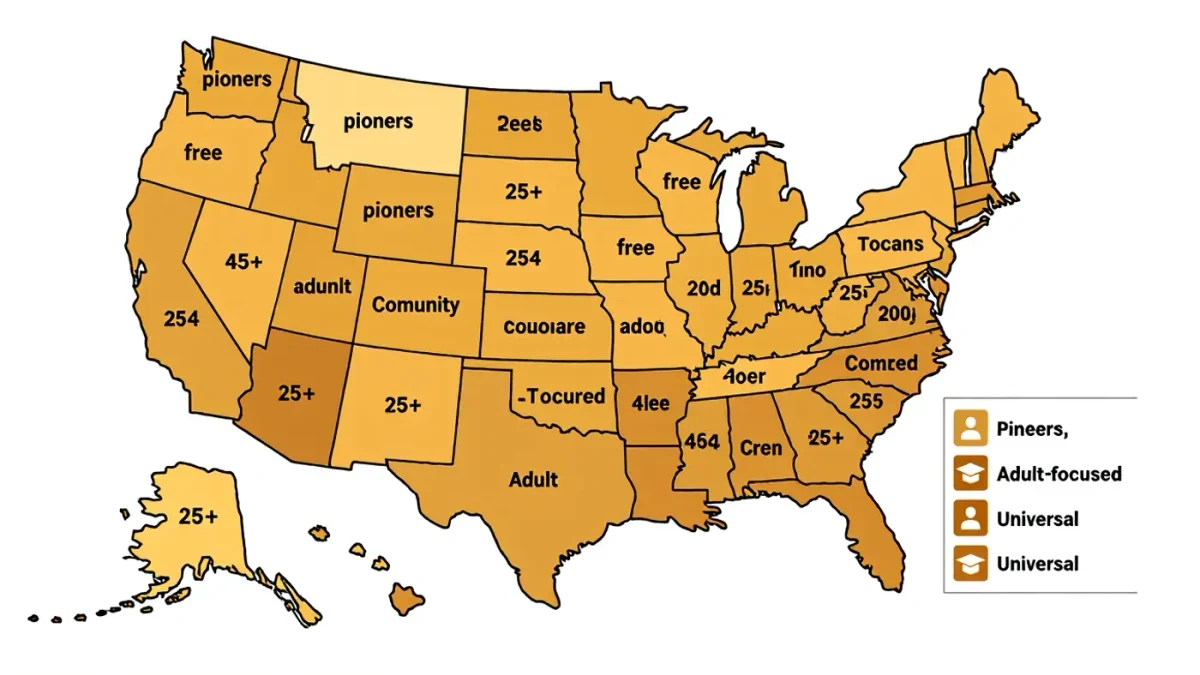
The map has three tiers. The pioneers — Tennessee, Oregon, and New York — built promise programs in the mid-2010s for recent high school graduates. The adult-focused wave came next: Tennessee Reconnect and Michigan Reconnect, launched in 2021, cover tuition for adults 25 and older without a degree. The newest tier is universal: MassReconnect began in fall 2023 for Massachusetts residents 25 and older, and MassEducate, signed in July 2024, extended free community college to all state residents who lack a bachelor's degree, covering tuition, fees, and an allowance for books. Michigan added its Community College Guarantee in fall 2024 for high school graduates from the class of 2023 onward.
How does a 'last-dollar' scholarship actually work?
The mechanics decide everything. A last-dollar program subtracts federal grants (typically Pell Grants, worth up to $7,395 for the 2025-26 award year), state aid, and institutional scholarships from the price of tuition and fees — then pays the remainder. If a Pell Grant already covers full tuition at an in-district community college, the promise program may contribute little or nothing directly, though many states add a separate allowance for books or supplies. The student's job is to file the FAFSA first, because last-dollar programs calculate off it. A handful of first-dollar designs exist that pay regardless of other aid, but they remain the exception.
What do these programs demand in return?
Promise money almost always carries behavior requirements, and families should know them before enrolling.
- Recent-graduate timing. Tennessee Promise and similar programs apply only to students who enroll within a set window after high school graduation — often the fall right after — with community service hours and mandatory mentoring, per the Tennessee Board of Regents.
- Enrollment intensity. Many programs require at least half-time enrollment, and some require full-time, which affects working students most.
- Progress rules. A minimum GPA and credit completion each term are standard; falling short can convert a 'free' year into a bill.
- Residency and location. Programs like Michigan Reconnect pay full in-district rates; attending an out-of-district college can leave a balance.
What does the evidence say about results?
The early returns are cautiously positive on access, mixed on completion. Promise programs measurably raise community college enrollment — early findings on MassReconnect showed a significant boost in adult enrollment in Massachusetts, and Michigan reported the same pattern after lowering eligibility ages. Degree completion is harder: national research on promise programs finds modest effects on graduation, partly because the students they pull in are often those who otherwise would have skipped college entirely and need advising support to persist. The states that pair free tuition with structured advising, as Tennessee does with mandatory mentoring, tend to show better retention.
How should a family evaluate a program?
A short checklist beats the marketing brochure.
- Confirm eligibility. Age, residency, high school graduation year, and prior degree limits — these five filters disqualify more applicants than grades do.
- File the FAFSA early. Every last-dollar calculation starts there, and state deadlines often land months before federal ones.
- Price the exact campus. In-district versus out-of-district tuition at the specific college changes the final number more than any other variable.
- Read the renewal rules. Ask the financial aid office, in writing, what GPA and credit load keep the scholarship alive for year two.
- Check transfer pathways. Free community college pays off most when credits transfer cleanly; ask which four-year state universities accept the degree block in the intended major.
Who benefits most?
Adults returning to finish a credential and first-generation students are the two clearest winners, per program enrollment data from the early state launches. For a working adult, free tuition removes the single biggest barrier to re-enrolling; Michigan's expansion of Reconnect eligibility toward younger adults in 2025 legislative budget talks reflected exactly that demand. For a high school senior weighing a four-year campus against two free years close to home, the honest math compares total debt at graduation — a question any family can now put real numbers under.
What is the realistic catch?
Two, and both are manageable. Free tuition covers tuition and fees, not living costs, transportation, or the income lost to class hours — so half of the real price of college remains the student's problem even where tuition is zero. And these programs live in state budgets: a recession can shrink them, which is a reason to enroll while terms are generous rather than assume they'll wait. Neither catch erases the underlying shift. A generation ago free community college existed nowhere; in 2026, a majority of states offer some version of it, and the family that checks the rules carefully can pay dramatically less than sticker price for the first two years of college.
What happens after the free two years?
The promise programs answer tuition for two years; what follows is a transfer question, and states have been wiring the paths deliberately. Most promise states maintain articulation agreements under which an associate degree from a community college satisfies the general education core at public four-year universities, so a transferring junior arrives with two years of credit intact. The financial planning point for families: junior and senior year at a state university remain full price, so the honest total-cost picture is two cheap years and two standard ones. Students who complete the associate degree first — rather than transferring early with scattered credits — protect the most credit under these agreements, per state transfer guides.
What should a returning adult check before enrolling?
Adults 25 and older are the fastest-growing group in these programs, and three checks save the most trouble. Prior credits: request old transcripts first, because credits from years ago often still apply and shorten the path. Employer tuition benefits: some employers reimburse tuition that a state promise program would otherwise cover, and the ordering rules differ by program. And program choice: short-term credentials in nursing, advanced manufacturing, and information technology frequently pair with state promise money and lead to immediate employment, which is why adult enrollment surged exactly in those fields in the early Michigan and Massachusetts data.
What if a student stops out mid-program?
Life interrupts, and the rules around interruption decide whether a promise becomes a debt. Most programs do not claw back money for completed terms, but they do pause eligibility: a student who drops below the credit or GPA threshold typically sits out a term or files an appeal before the scholarship resumes. The adult-focused programs tend to be the most forgiving, allowing part-time pacing and re-entry after a stop-out. Families should ask the financial aid office one direct question — what exactly restores eligibility after a bad term — and keep the answer, because the student who knows the re-entry rule is far more likely to finish than the one who assumes a stumble ends the program.