Tenth grade is the best year to explore career interests, because nothing counts yet — no applications loom, grades matter but don't lock doors, and the free tools are excellent. The U.S. Bureau of Labor Statistics publishes the Occupational Outlook Handbook, an honest, regularly updated guide to hundreds of occupations with median pay, required education, and job projections. A sophomore who spends a few weekends with it, plus some low-stakes real-world testing, arrives at junior year with direction instead of dread. The goal isn't choosing a career at fifteen; it's collecting evidence.
This is information, not advice — every school's course offerings differ, and the point is adapting the process below to what your district actually offers.
Why start in tenth grade at all?
Timing. Junior year is consumed by hard courses, tests, and the college or postsecondary conversation; seniors are already deciding. Sophomores have room to take a class that might not pan out, shadow a professional who might not inspire, and change their minds for free. Career researchers describe early exploration as widening before narrowing — and tenth grade is the widest, cheapest window a student will ever get.
There's also a practical hook: course selection for junior and senior year usually happens in the spring of tenth grade. A student who has explored even lightly chooses electives, CTE pathways, or dual-credit courses on purpose rather than by schedule convenience.
What free tools should a tenth grader actually use?
Three, used in this order, beat most paid programs.
- The Occupational Outlook Handbook (BLS): every profile lists what the work is like, education required, pay, and the BLS employment outlook. Ten occupations read seriously — following curiosity, not logic — is a weekend well spent.
- Your school's career inventory or interest survey: many districts license formal assessments; results are conversation starters, not verdicts.
- Real people: one 20-minute conversation with an adult who does an interesting job teaches more than ten articles. Most professionals say yes to a polite student email — someone once said yes for them.
How does a student test an interest without committing?
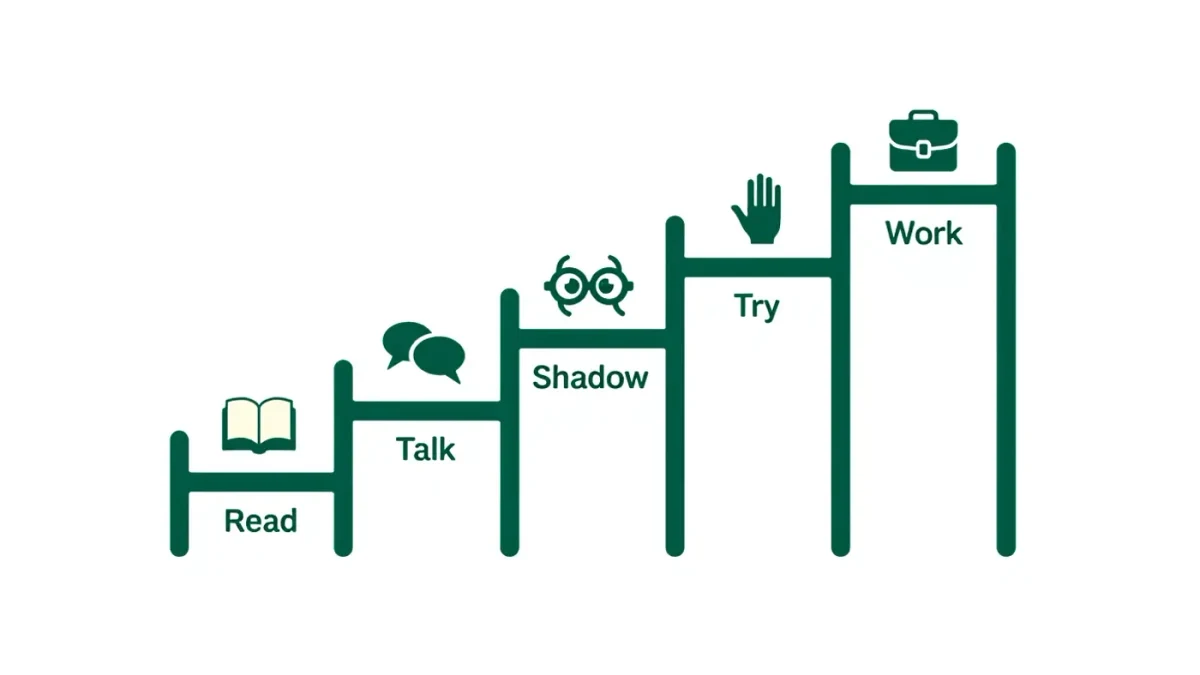
Through graduated exposure. Think of it as a ladder, where each rung costs a little more time and teaches a lot more than the last:
- Read — OOH profiles, a memoir, YouTube day-in-the-life videos from actual practitioners.
- Talk — the informational interview, by video or over coffee with a family friend or friend-of-a-friend.
- Watch — a job shadow for a day, arranged through family networks or school programs.
- Do — a club, a summer camp in the field, a volunteer role with real tasks, a small side project.
- Work — a part-time job, internship, or CTE course that includes workplace experience.
Most interests die honestly somewhere on steps one through three, which is success, not failure — the whole point is cheap eliminations. The ones that survive step four are worth real investment in eleventh grade.
What role do school programs play?
More than most families ask about. Career and technical education has expanded in many states, and many high schools now offer pathway programs — health sciences, information technology, skilled trades, education, business — sometimes with industry certifications built in. Dual enrollment can put a tenth or eleventh grader in a real college course. Clubs from robotics to DECA to HOSA are essentially career exposure disguised as extracurriculars.
The ask that unlocks all of it is one counselor meeting in the spring: "What pathway, CTE, and elective options does our school offer, and which have real workplace contact?" Bring the student's short list from the exploration ladder; leave with a junior-year plan.
What should parents avoid doing?
Three familiar traps. Projecting — treating the student's exploration as a second run at the parent's own unrealized plan. Prestige-filtering — steering away from perfectly good paths because they lack status; the BLS projections show steady demand in fields that don't require a four-year degree, and the Handbook's data is the antidote to dinner-table folklore. And over-scheduling — exploration needs slack; a student with every hour programmed has no room to follow curiosity.
The parent's highest-value moves are logistics and connections: knowing an engineer who'll take a coffee meeting, driving to the shadow day, asking the school the right questions. The choosing stays with the student.
How do you know it's working?
Not by the student announcing a career. Signs of progress are subtler: they can name fields they've ruled out and say why; they ask to take a class that has a clear purpose; they initiate the next rung of the ladder themselves. A tenth grader who says "I don't know yet, but I know I want to work with people, not code" is exactly where the research says a fifteen-year-old should be — and far ahead of the peer who's never tested anything.
How do you run a good informational interview?
The informational interview is the single most underrated exploration tool, and it's almost free. The recipe that works: a student (not the parent) emails a family connection or a professional in a field of interest, asks for twenty minutes, and arrives with five questions. Parents contribute the introductions — "your uncle's friend who does physical therapy" — and then stay out of the room entirely, including on the call.
The five questions that consistently produce honest answers: What does an ordinary Tuesday actually look like? What surprised you about this work? What do people wrongly assume about it? What skills matter most in the first two years? And what would you tell a fifteen-year-old who's curious about this path? The last question reliably produces the most useful material, because adults rehearse the answer to it more than they realize.
Afterward, the thank-you note is the lesson inside the lesson. A two-line email sent within a day, mentioning one specific thing from the conversation, converts a stranger into a permanent contact — and it teaches the professional-communication habit that will later win internships. Encourage the student to keep a short log of every conversation: what they learned, and what surprised them. Three or four of these logs read side by side often reveal a pattern — a recurring interest in the people-side of a field, or in the building-and-fixing side — that no assessment produces as convincingly.
Set expectations honestly: some interviews flop, some adults talk in clichés, and one will accidentally talk the student out of a career, which is the whole thing working. The information that ends a bad fit early is exactly as valuable as the information that confirms a good one — and at fifteen, it's the cheapest it will ever be to get.
What happens after tenth grade?
Junior year converts exploration into choices: courses that align, a summer job or program with intent, a college or postsecondary list built around programs that actually fit. None of that works without the raw material gathered now. Ten weekends with the BLS Handbook, five conversations, one shadow day — small inputs, in the single year when their payoff is largest.