Active reading means reading with a pen and a question, and it beats passive rereading decisively. On the National Assessment of Educational Progress, the country's report card for reading, average scores fell three points at both fourth and eighth grade between 2019 and 2022 — a dip that made comprehension strategy a household concern — while decades of cognitive research show the single weakest study move students love most is rereading a clean page.
The good news is that active reading is not a talent; it is five small moves anyone can make with a pencil. Here is what they are, why they work, and how to get a resistant reader to actually use them.
What Makes Reading "Active"?
Active reading is any habit that forces the reader to produce something while reading — a question, a prediction, a summary line, a connection to a previous page. The production is the point. Comprehension is not what happens to your eyes; it is what your brain does with the words afterward, and every mark in the margin is a small rehearsal of that processing.
The contrast with rereading is stark. Rereading feels effective because the second pass feels smooth — psychologists call that fluency "recognition," and the brain misreads it as knowing. Testing yourself, by contrast, feels harder and works better. This is one of the most replicated findings in learning science: students who practice retrieving information outperform students who review it, on nearly every kind of material studied since the classic memory experiments of the twentieth century.
What Are the Five Moves?
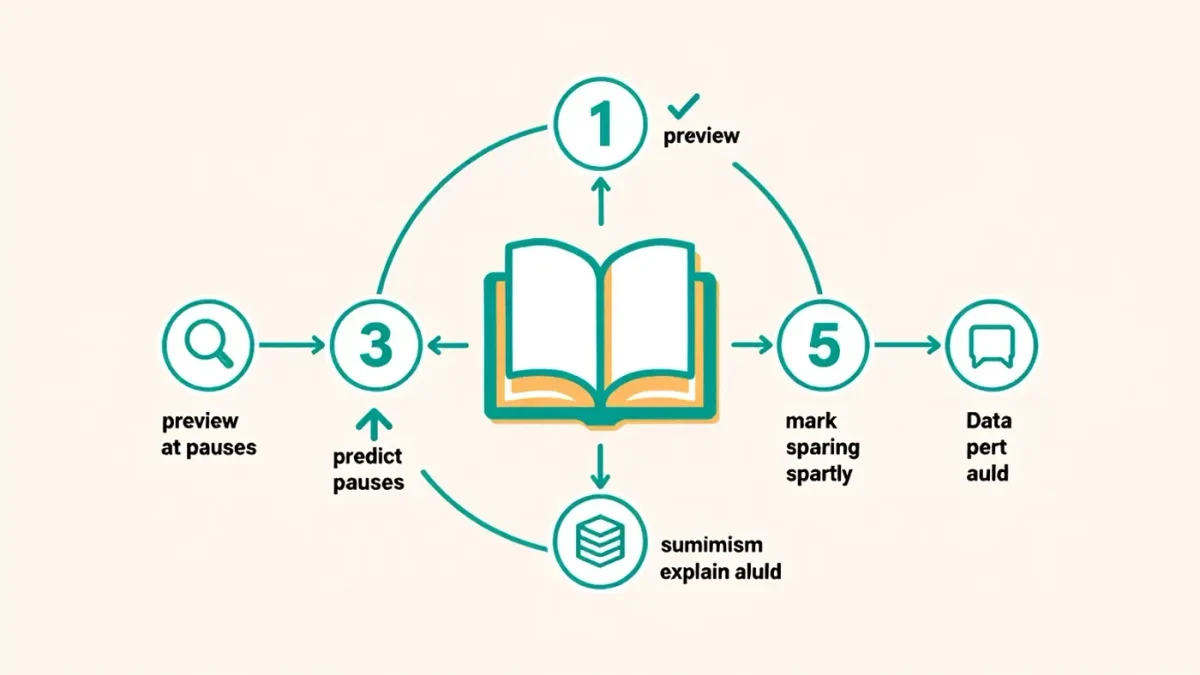
These five habits cover fiction, textbooks, and primary sources alike. They cost a minute apiece.
- Preview with a question. Before reading, spend ninety seconds on the title, headings, and pictures, then write one question the chapter should answer. A brain holding a question reads differently — it hunts.
- Predict at the pauses. At each section break, jot three words about what comes next. Wrong predictions are fine; in fact they anchor the correction, which is where memory forms.
- Mark sparingly. A symbol system keeps the pen honest: a star for a main idea, a question mark for confusion, a bracket for a likely test fact. If everything is highlighted, nothing is — one line per page is a good ceiling.
- Summarize at the bottom. After each section, one sentence in the reader's own words at the bottom of the page or on a sticky note. This is the single highest-value move in the set, because a summary cannot be copied; it must be understood.
- Explain it to someone. After the chapter closes, two minutes of explaining the reading aloud — to a parent, a sibling, a phone recording — exposes every soft spot while there is still time to reread the right page.
Does This Work for Novels, or Just Textbooks?
Both, with the emphasis shifted. Fiction rewards prediction and character tracking: a sticky note per chapter naming what each major character wants, and a running guess about how the conflict resolves. Readers who annotate novels this way retain plot and motivation far longer, which matters because literature exams test interpretation, not recall.
Textbooks reward the question-first preview and the section summary, because textbook chapters are pre-organized for it — headings are literally the questions the section answers. Turning every heading into a question before reading, then checking whether you can answer it after, converts an assigned chapter into a practice test the teacher never had to write.
Vocabulary deserves one slot of its own, because unknown words are where comprehension quietly dies. The active reader circles unfamiliar words — without stopping the first time — and returns at the section break to guess each meaning from context before checking a definition. Guessing first feels clumsy, but it is precisely the effort that makes the definition stick; a looked-up word alone is forgotten within days.
What About Annotating on Screens?
The mechanics transfer, with one honest caveat. Digital texts support highlights and notes, and students should use them — but the evidence suggests marking on screens drifts toward highlighting everything, the least useful move. Two workarounds help: require one typed summary sentence per section in a notes file, and where a device allows it, use a stylus to write margin notes by hand, which preserves the slower, processing-heavy quality that makes annotation work.
For long digital assignments, printing the key pages is not nostalgia; it is strategy. Whatever keeps the pen moving and the summaries flowing is the right medium.
For dense assigned texts — a primary source in history, a Shakespeare act — one more pass helps: read a summary of the whole piece first, then read the original with the pen. Knowing the shape of the argument in advance frees attention for the language, which is the level the assignment usually tests.
How Do You Get a Reluctant Reader to Do Any of This?
Start smaller than feels necessary. A reluctant reader's first assignment is not five moves on a twenty-page chapter; it is one sticky note on two pages. The skill grows by volume of repetitions, not intensity of lectures. Reading researchers and classroom teachers converge on the same advice here: model the moves rather than assign them. A parent reading the same article and marking it aloud for two minutes teaches more than a rubric.
Choice is the other lever. Whatever the school assigns, the moves should first be practiced on something the student chose — a sports profile, a piece about a game they play, a biography of a musician. The strategy does not care about the material; the motivation does.
How Can Families Tell Whether It Is Working?
Watch the notebook, not the grades, at first. A reader doing this work produces visible artifacts — margin symbols, section summaries, sticky notes with real sentences — within a few weeks. Comprehension gains follow over a semester, and they show up first not in test scores but in what the reader can say about a text days later.
The national numbers frame the stakes without framing any one child: the 2019-to-2022 NAEP reading decline was the widest on record at the time, and while averages describe systems rather than students, they explain why comprehension strategy is suddenly everyone's business. A pen, a question, and a sentence per section are small tools against a large problem — but they are the ones the evidence supports.