A homework routine sticks when it runs on a fixed time, a fixed place, and a visible finish line — not on willpower. A 2006 Duke University meta-analysis of dozens of homework studies found homework's link to achievement grows sharply in the secondary grades, and the commonly cited guideline of about ten minutes per grade level, endorsed by both the National Education Association and the National PTA, gives families a sanity check on volume.
Every routine fails for the same few fixable reasons: no defined start, no defined end, and a phone within reach. Fix those three and most evenings take care of themselves. Here is how, step by step.
Why Do Most Homework Routines Fall Apart by October?
Routines die because they depend on how the student feels. A plan that requires a tired twelve-year-old to "decide" to start at 7 p.m. loses every busy week. A plan where 7 p.m. simply is homework time — like brushing teeth before bed — survives, because nothing has to be decided and nothing can be negotiated nightly.
The second killer is the missing finish line. When homework is an open-ended slog until a parent surrenders, students learn that working slowly extends nothing but misery. When the routine ends at a set time — with anything unfinished handled the next morning by the student, not the parent — dawdling stops paying.
The third is the environment. A phone on the desk is not a distraction risk; it is the distraction. Students who keep the phone in another room during homework block consistently report finishing faster, simply because no five-second check-ins fragment the work.
What Does a Workable Routine Look Like?
The shape matters more than the exact times. A workable template for most secondary students looks like this.
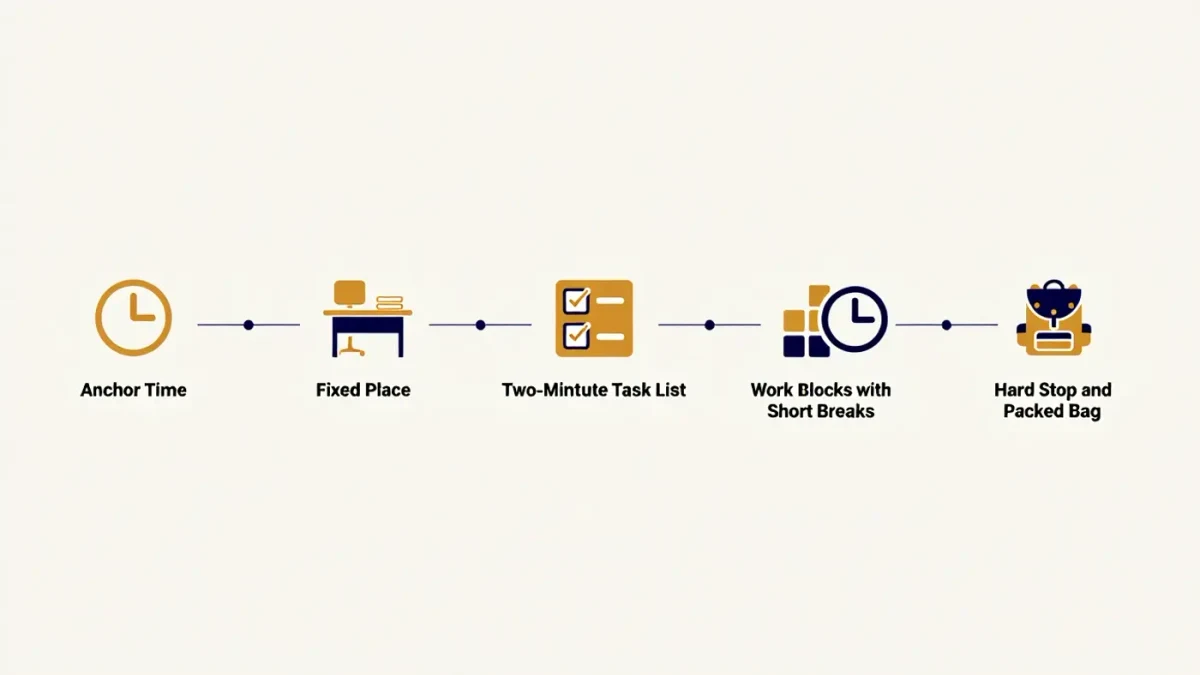
- One anchor time. Homework starts at the same time every school night, ideally after a snack and a short break but before dinner or immediately after it. Pick the slot the family can defend five nights a week.
- One anchor place. The same desk or kitchen table, with supplies in reach so nothing derails into a twenty-minute search for a ruler. Kitchen tables work well for many families because presence is supervision enough.
- A two-minute launch. The student writes tonight's tasks on a sticky note or planner page and numbers them hardest-first, while energy is highest. Deciding the order is part of the work.
- Work blocks with real breaks. Twenty-five to forty minutes of work, then a five-minute break that involves standing up — not a screen, which turns five minutes into forty.
- A hard stop. At the set end time, homework is done for the night. Anything truly unfinished gets a note to the teacher or an early-morning slot, handled by the student.
- A shutdown minute. Pack the bag, put it by the door, and glance at tomorrow's schedule. Mornings get calmer as a bonus.
How Long Should Homework Take Each Night?
The widely used benchmark from the NEA and National PTA is roughly ten minutes of homework per grade level per night — about an hour in sixth grade, up to about two hours by twelfth. The Duke meta-analysis that brought order to this research, led by Harris Cooper, found the homework–achievement link is strongest in grades 7 through 12 and much weaker in elementary school, which is a useful fact for families of younger children staring at oversized packets.
If a student is routinely far past these marks, treat it as information, not a character flaw. Common causes include unfinished classwork masquerading as homework, a phone in the workspace, an unrecognized reading difficulty, or genuinely heavy teacher assignments. The first fix is data: have the student log actual work time for two weeks, then take the log to the teacher. Most teachers would rather adjust than never hear anything until spring.
| Grade | Rough nightly benchmark | What to do if reality is double |
|---|---|---|
| 3–5 | 30–50 minutes | Check with the teacher; elementary gains from homework are small |
| 6–8 | About 60–80 minutes | Log actual time, remove the phone, revisit hardest-first ordering |
| 9–12 | 90–120 minutes | Compare across teachers; ask about priority order and late policies |
How Much Should Parents Be Involved?
Less than instinct suggests, and more predictably than most families manage. The parent's job is the structure — the anchor time, the phone rule, the supplies — and the emotional weather. The student's job is the work itself, including its honest failures. A routine where the parent checks every answer teaches the student that someone else is responsible for quality.
The highest-value parental move is the two-minute check-in at launch: what's tonight's list, what's hardest, what's the plan for it. That brief conversation builds planning skill without touching the content. Then step away. Struggling in front of a student a little is part of learning; rescuing every stuck moment is not.
What If the Routine Breaks Anyway?
It will — after illness, holidays, and bad weeks. Routines that last are the ones that restart cheaply. Do not rebuild the whole system; just reinstate the anchor time tomorrow. Families who treat a broken streak as a single lost day recover in a day. Families who treat it as proof the student is lazy lose months.
If resistance is sharp and persistent, look below the surface. Chronic homework refusal in an otherwise willing student often traces to a skill gap — the work is genuinely too hard to face alone — or to anxiety that deserves a gentler conversation than a stricter schedule. That is a moment for a parent-teacher conference, not a tougher routine.
One more quiet rule helps: homework is not a punishment, and it is not a negotiation either. Families that describe the routine as "how evenings work in this house" — the same tone used for seatbelts — spend far fewer minutes arguing than families who re-litigate the arrangement every September. Tone does a lot of the lifting that checklists cannot.
Start small: one anchor time, one place, phone in the other room, hard stop. Most families see calmer evenings within two weeks, and calmer evenings are the point — the studying improves because the student, not the parent, is finally running the process.