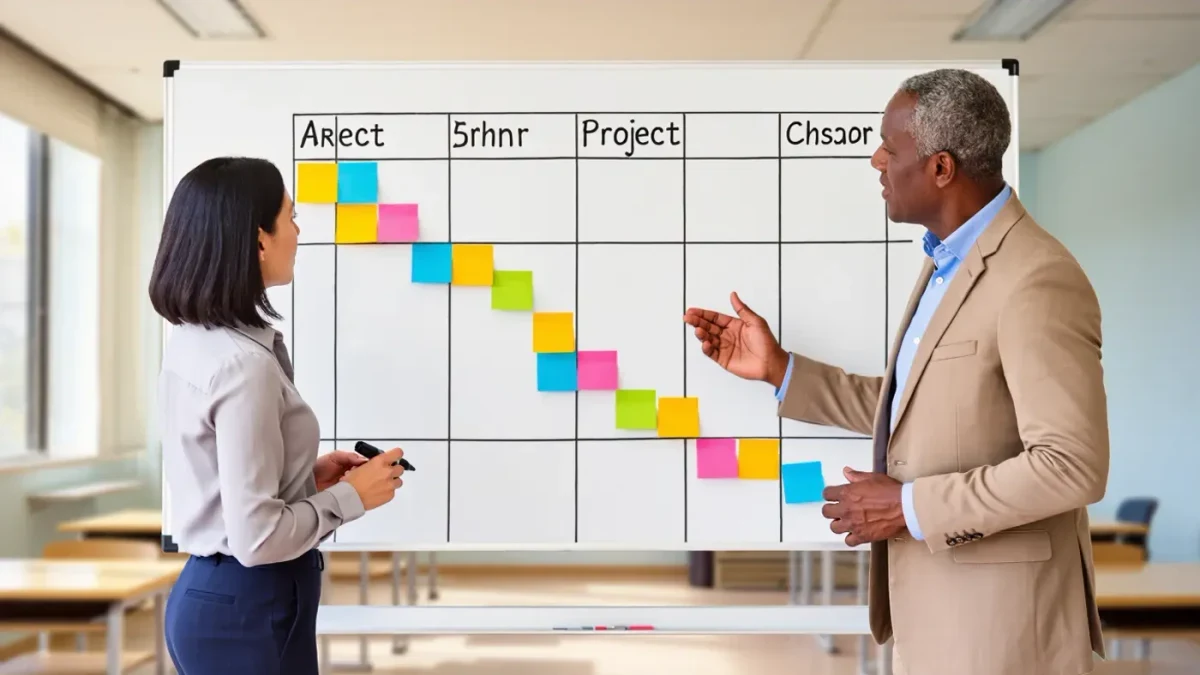
Long-term projects get planned backward, not forward. Students who start from the due date and slice it into weekly pieces finish; students who start from "read the rubric" and trust future motivation drown in the last weekend. Randomized studies funded by Lucas Education Research and published beginning in 2021 found that students in well-structured project-based courses outperformed peers in traditional classes — but the operative word is structured, and structure is exactly what a twelve-year-old is still building.
Middle school is when multi-week assignments first arrive in volume — science fairs, research papers, book trailers — and it is also when the brain's planning machinery, called executive function, is famously still under construction. The fix is not character. It is a system small enough to run.
Why Do Smart Students Blow Up Over Long Projects?
Because planning lives in the prefrontal cortex, the last part of the brain to mature, and because long projects hide their danger. A test announces itself; a three-week project feels safe for two of those weeks. Psychologists call the pull toward the deadline "temporal discounting" — far-off consequences feel weightless, near ones feel heavy — and it hits adolescents harder than adults, not because they are lazy but because their reward circuitry is tuned to the immediate.
The other trap is vagueness. "Work on the Egypt project" is not a task; no one has ever done it. "Write the three questions I want to answer about Egyptian farming" is a task, and it takes twelve minutes. Most project paralysis is really the absence of a next step small enough to start.
What Is Backward Planning and How Does It Work?
Backward planning starts at the deadline and walks home. On one sheet, the student writes the due date at the bottom and fills in deadlines above it, each one a real, checkable thing.
- Reserve the ending. The final two days before the deadline are for polishing, printing, and practicing — never for making anything. If the poster is being made the night before, the plan failed a week earlier.
- Set the pieces. Every project decomposes into parts: research, notes, outline, draft, images, final product. List them in order above the ending block.
- Attach dates to pieces, not feelings. "Outline finished by Friday the 10th" is a deadline. "Get a good start sometime this week" is a mood.
- Build in one buffer week. Something always goes wrong — the printer, the flu, the source that vanishes. A plan with no slack is a plan with a hole in it.
- Choose tonight's twelve minutes. The plan ends, today, with one tiny first step: naming three questions, checking out one book, opening the document and typing the title. Momentum is chemical; starting is the only hard part.
What Tools Help Without Becoming the Project?
The best tool is the one that survives contact with a backpack: a single page taped above the desk or a paper planner spread works better for most middle schoolers than any app with notifications. The tool needs exactly three features — the piece list, the dates, and a way to check things off. Elaborate project boards become their own procrastination.
One upgrade earns its keep: the "next physical action" rule. Beside every date, the student writes what the hands will literally do — "take 20 notecards from the box," "email the librarian the question." Parents are often startled by how much of project paralysis dissolves when the next action is phrased physically.
How Much Should Parents Help?
Help with the system, not the project. A parent can sit beside the student for the first backward-planning session, ask the calendar questions — "what has to exist a week before this is due?" — and then step back. A parent who builds the timeline alone has taught the student that timelines come from other people, which works exactly until the day it stops.
The check-in cadence that works is short and scheduled: two minutes on Sunday to look at the week's dates, and a neutral "what's your next step" on Wednesdays. What sinks projects is the nightly interrogation — it makes the project a site of conflict, and adolescents will sacrifice a grade to win an argument.
And when the plan collapses, as early plans do, the lesson is the rebuild. Sit down again, walk backward from what remains of the timeline, and cut scope honestly — three strong examples instead of six thin ones. Teachers respect a finished smaller thing far more than an ambitious half-thing, and a student who has rescued one collapsed plan owns a skill no smooth run teaches.
How Do Teachers Make This Easier — and What Can Families Ask For?
Many schools now build the scaffolding in deliberately, because the research on structured project-based learning shows the approach pays when checkpoints are explicit. Teachers who post intermediate deadlines, run one-minute conferences at each checkpoint, and show exemplar projects from past years are doing half of this guide inside the classroom.
At back-to-school night, it is fair to ask how long projects are scaffolded: Are there checkpoints? Is class time given for research? What does the rubric weigh — process or product? The answers tell a family how much of the planning load falls at home, before the first crisis, not after.
A note on group projects, the special circle of middle-school planning: the same sheet works, but add a name beside each dated piece. Vagueness multiplies in groups — "we'll do the research" means nobody does it — while "Maya: sources by Tuesday; Daniel: outline by Friday" holds. A student who learns to ask "who, and by when" at the first group meeting has learned the adult version of this skill.
Where Does This Skill Go After Middle School?
Everywhere. High school brings capstone papers and college applications with real deadlines; jobs bring projects with checkpoints and managers. The student who learned at twelve to walk a deadline backward, write physical next actions, and keep one buffer week will run group projects in college while teammates are still "about to start." That is the quiet return on a few frustrating evenings with a roll of tape and a paper calendar now.