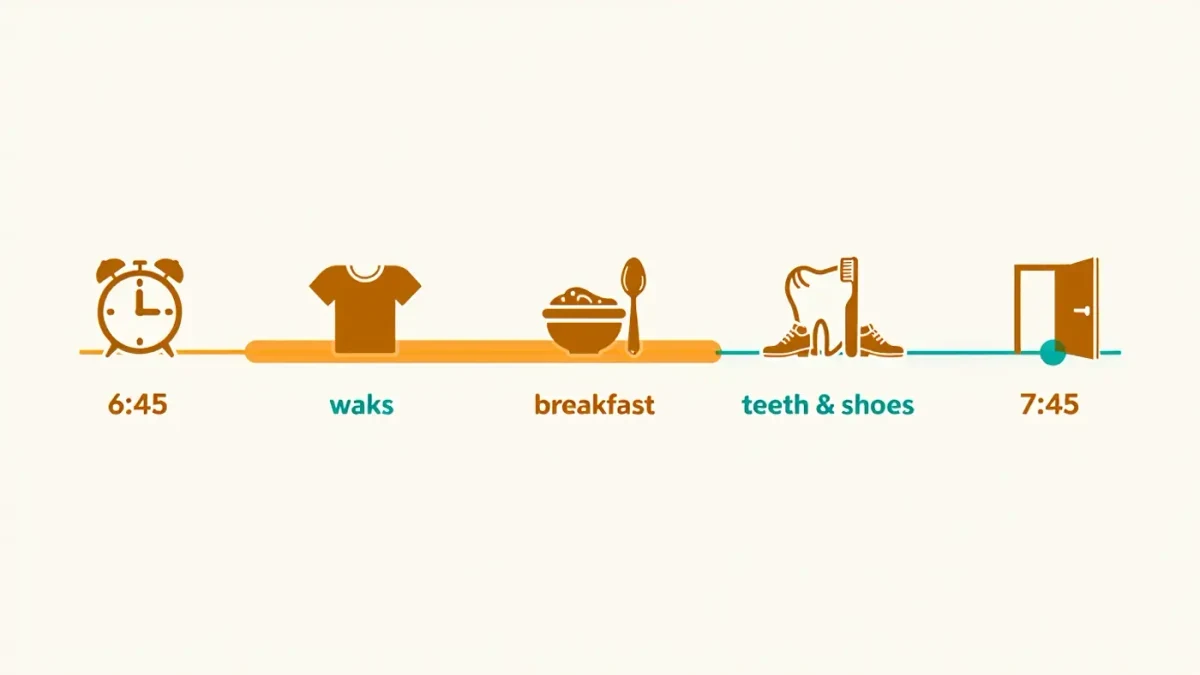
A school-year morning routine survives on two things: everything that can be done the night before is, and everyone gets enough sleep — school-age children need 9 to 12 hours and teenagers 8 to 10, per American Academy of Pediatrics guidance echoed by the CDC's sleep recommendations (CDC, 2024). Wake-up time, outfits, backpacks, and breakfast decisions belong to the evening; the morning should be execution, not design. Families who reverse that order are the ones renegotiating socks at 7:40 every day until June.
This is information about routines and sleep, not medical advice — if mornings involve chronic exhaustion or a child who cannot wake at all, that is a conversation for your pediatrician. What follows is the version that lasts past October.
Why do our mornings fall apart by week three?
Because most morning routines are built on adrenaline and novelty, and both run out. The first week of school runs on excitement; week three runs on a tired child, a tired parent, and a routine that secretly depended on everyone being fresh. The fix is moving decisions out of the morning entirely and making the remaining steps so few and so fixed that they run without discussion.
Count your current morning's decision points — clothes, breakfast, permission slips, shoes, hair, lunch — and aim to delete half of them by 8 p.m. the night before. A morning with three decisions is recoverable; a morning with nine is a daily negotiation.
What belongs in the night-before list?
Everything that does not spoil. The short version that works across ages:
- Backpack packed, homework in, water bottle filled, by the door.
- Clothes chosen — or a weekly outfit organizer for younger children who fight this daily.
- Lunch packed or the school-lunch decision made and written down.
- Breakfast plan agreed, even if it is just "eggs Tuesday, oatmeal Wednesday."
- Devices charging outside bedrooms — which also protects the bedtime that makes the morning possible.
How much time does the morning actually need?
Time it honestly once. Wake-up to out-the-door for an elementary child is typically 45 to 60 minutes; teens with showers and transport realities often need 60 to 90. Now work backward from the departure time — and if the math says wake-up before 6 a.m. for a child who fell asleep at 10:30, the problem is not the routine, it is the bedtime, and no checklist will out-run that arithmetic.
Build in a ten-minute buffer you protect fiercely. The buffer absorbs the lost shoe, the sudden breakfast veto, and the traffic — without it, every morning ends in a sprint, and sprints are where the yelling lives.
How do I keep a young child on track without narrating every step?
Make the routine visible and let the checklist be the boss, because children argue with a laminated card far less than with a parent. A picture chart for pre-readers — wake, dress, eat, teeth, shoes, out — and a written list for readers, hung at their eye level. Ask "what's next on your list?" instead of issuing the instruction yourself; the question transfers ownership one step at a time.
Keep distractions physically out of the path: no television until shoes are on and bags are shouldered, devices stay in the parents' room until after school. Rewards are rarely needed — the payoff is the calm ten minutes that remain before the bus, spent together rather than on commands.
What if mornings are fine but the child never eats?
Breakfast resistance is usually a timing problem wearing a food problem's clothes. A child who wakes at the last possible minute is not hungry yet — appetite needs twenty minutes of being upright — so the fix is moving wake-up earlier, not negotiating harder at the table. Offer small and fast: a yogurt, a banana with peanut butter, toast eaten standing up. Schools with breakfast programs are the backstop; a meal at 7:50 with friends often goes down easier than one at 6:50 under supervision.
Skip the lectures about metabolism and mornings. The realistic goal across childhood is some fuel most days, protein when you can get it, and a habit that does not require a negotiation session before the sun is fully up.
What changes for teenagers?
Everything and nothing: the structure stays, the ownership doubles. Teens need multiple alarms of their own, a realistic shower slot, and control over the sequence — some eat first, some dress first, and it genuinely does not matter which. What does not work is a parent performing the wake-up loop in person five mornings a week; by high school the routine should run on the student's own clock with yours as backup for genuine failures.
The one non-negotiable worth keeping is the phone curfew, because teen sleep is under enough pressure from schedules and biology — adolescent circadian rhythms shift later, which is why early bells hit teens hardest — without a feed in the dark adding another hour of lost rest.
| Time | Child's steps | Parent's steps |
|---|---|---|
| Night before, by 8 p.m. | Pack bag, lay out clothes | Sign slips, set breakfast plan |
| Wakeup minus 0–15 min | Dress, bed made if it's a rule | Breakfast on, own coffee |
| 15–40 min | Eat, hygiene, hair | Quiet presence, not direction |
| Last 10 min | Shoes, bag, water bottle | Buffer — protect it |
| Out the door | Same time daily | One warm sentence, no lecture |
How do we restart after it collapses?
Without a tribunal. Every routine collapses — after illness, holidays, the February slump — and the families who recover fastest restart the night-before list the same evening, without a speech about what went wrong. Reset the bedtime first, the checklist second, and the buffer third, in that order, because a rested child makes a checklist work and no checklist rescues an exhausted one.
Aim for boring. The best school-year mornings are the ones nobody remembers by lunch: bags by the door, a breakfast nobody debated, and a goodbye that did not have to be shouted through a closing door. Build the system in August, pay for it with sleep every night, and by September the routine will be carrying the family instead of the other way around.