The science of reading movement rewired how most American schools teach reading: since 2019, roughly 40 states and the District of Columbia have passed laws or policies requiring reading instruction grounded in phonics, teacher training in language foundations, and in many cases screening for reading risk in kindergarten through third grade. The shift followed decades of research on how children actually learn to decode words — and the widely documented failure of balanced-literacy programs that encouraged guessing from pictures and context. For families, the change shows up in the materials on the table: decodable books instead of leveled ones, and questions about sounds instead of questions about pictures.
A note on scope: this is an explainer about a policy and instructional shift, not a reading program recommendation. Children differ, and struggling readers need individual assessment.
What does "science of reading" actually mean?
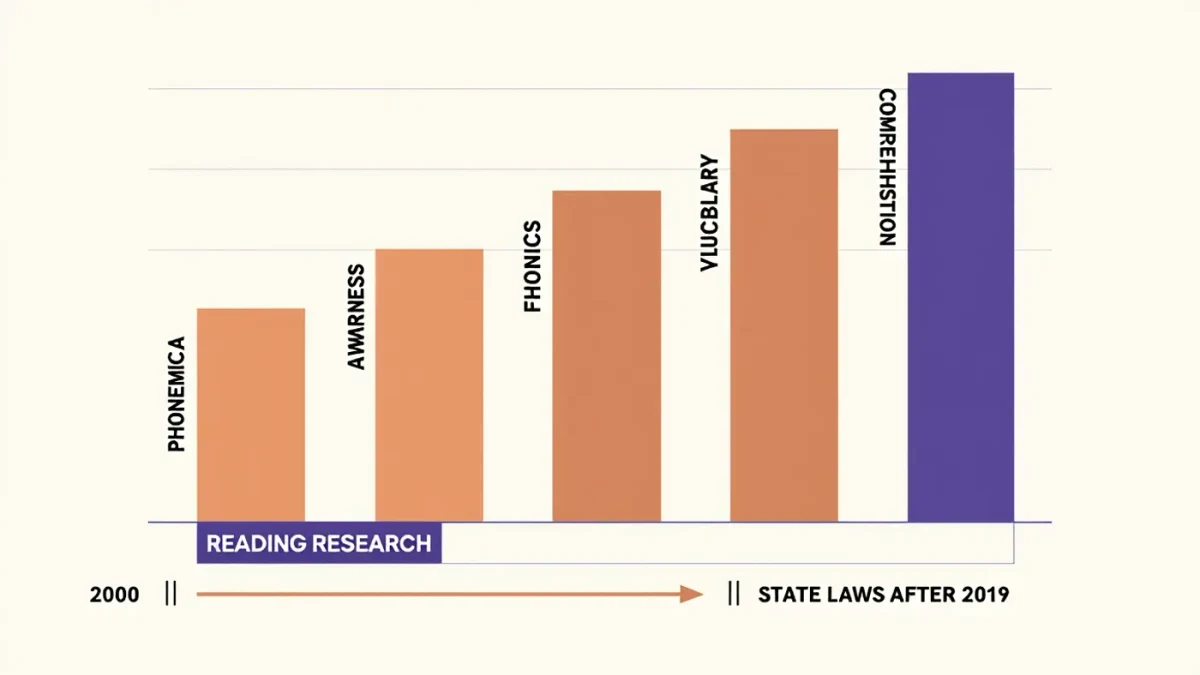
It is shorthand for a body of research — spanning cognitive psychology, linguistics, and neuroscience since the 1970s — showing that reading is not acquired the way spoken language is, and that most children need explicit, systematic instruction in how letters map to sounds. The National Reading Panel's federally commissioned review in 2000 identified five pillars: phonemic awareness, phonics, fluency, vocabulary, and comprehension. The "science of reading" label became a movement when that research collided, publicly, with what was actually happening in classrooms — an accounting that journalism starting in 2018-19 and state test data forced into the open.
What was wrong with the old approach?
The dominant programs of the 1990s and 2000s, often grouped under balanced literacy or whole language, taught students strategies for attacking unfamiliar words that the research does not support: look at the picture, skip the word, guess from the first letter and context. Those strategies work often enough to fake success in early grades with predictable texts — and collapse around fourth grade, when books stop carrying pictures and the words stop being guessable. Researchers have long called this the instruction gap's quiet failure mode: kids who look like readers until the text gets hard. The strongest readers were never depending on the guessing cues in the first place, which is why the harm concentrated among students with the least reading support at home.
What changed in state policy?
Mississippi ran the template. Its 2013 Literacy-Based Promotion Act required reading screening, teacher training in the science of reading, and retention offers for third graders well behind in reading — and over the following six years the state rose from near the bottom of national fourth-grade reading results to roughly the national average, a climb documented on the federal National Assessment of Educational Progress and widely studied. After journalism in 2018-19 popularized the research and Mississippi's results, the legislative dam broke: per counts maintained by education policy trackers, roughly 40 states plus D.C. had enacted reading laws by the mid-2020s, most covering some combination of curriculum requirements, teacher preparation changes, K-3 screening, and funding for tutoring and training.
What looks different in a classroom now?
Four visible changes.
- Decodable texts. Books engineered to use only the sound patterns a child has been taught, replacing texts engineered to be guessable from pictures.
- Explicit phonics sequences. Letter-sound relationships taught in a planned order — consonant blends, vowel teams, syllable types — rather than as they happen to appear in stories.
- Universal screening. Brief early-literacy assessments, typically three times a year, that flag students at risk for reading difficulty — including dyslexia — far earlier than waiting for failed report cards.
- Teacher retraining. Thousands of current teachers have completed training such as language-arts programs built on the research foundations, a professional-development undertaking on a scale education rarely attempts.
What did the movement get right, and where are the honest critiques?
The core claim — that systematic phonics outperforms guess-based approaches for early reading, particularly for the most vulnerable students — is among the most settled findings in education research, affirmed by the National Reading Panel and decades of studies. The critiques are real too. Some districts implemented phonics-heavy programs so rigidly that vocabulary, knowledge-building, and the joy of books got squeezed, though comprehension research says background knowledge is exactly what comprehension runs on. Retention policies remain contested, with researchers split on whether holding back third graders helps or harms in the long run. And curriculum mandates do not teach children; teachers do, which is why the training investment matters as much as the materials.
What does this mean for parents?
If your child is in K-2, expect decodable books in the backpack — and if picture-guessing strategies come home instead, that is a question worth raising at a conference, respectfully and early. If your child struggles despite good instruction, ask whether the school's screening flagged it and what the follow-up is: the federal Individuals with Disabilities Education Act entitles children with reading disabilities including dyslexia to evaluation. The What Works Clearinghouse, the Education Department's evidence-review arm, publishes reviews of reading programs if you want to see the research base behind what your district adopted.
What about older students who never got this instruction?
The laws mostly target K-3, and the awkward fact is that a large cohort of upper-elementary, middle, and high school students arrived there under the old methods. Researchers and curriculum developers have responded with what is usually called structured literacy for older students: the same explicit instruction in word recognition, delivered age-respectfully, alongside the vocabulary and knowledge work adolescents also need. A sixth grader still guessing at multisyllabic words is not stuck by nature; decoding is teachable at any age, and interventions for adolescents have research support, though they take longer than early screening would have. For parents of an older struggling reader, the two questions that matter are whether the school has assessed the student's actual decoding skills — not just comprehension — and whether any intervention being offered targets word recognition explicitly. Accommodations like audiobooks have a real place, but they substitute for reading rather than teaching it, and a fair plan usually does both.
Where does the movement go from here?
The laws are passed; the implementation decade is now. Watch two things in your own state: whether teacher preparation programs actually changed what new graduates know about reading, and whether the early-screening data translate into real small-group intervention — screening without follow-up is measurement, not teaching. The movement's lasting test is not the legislation count but whether fourth-grade reading moves, especially for the students the old approach failed quietest.