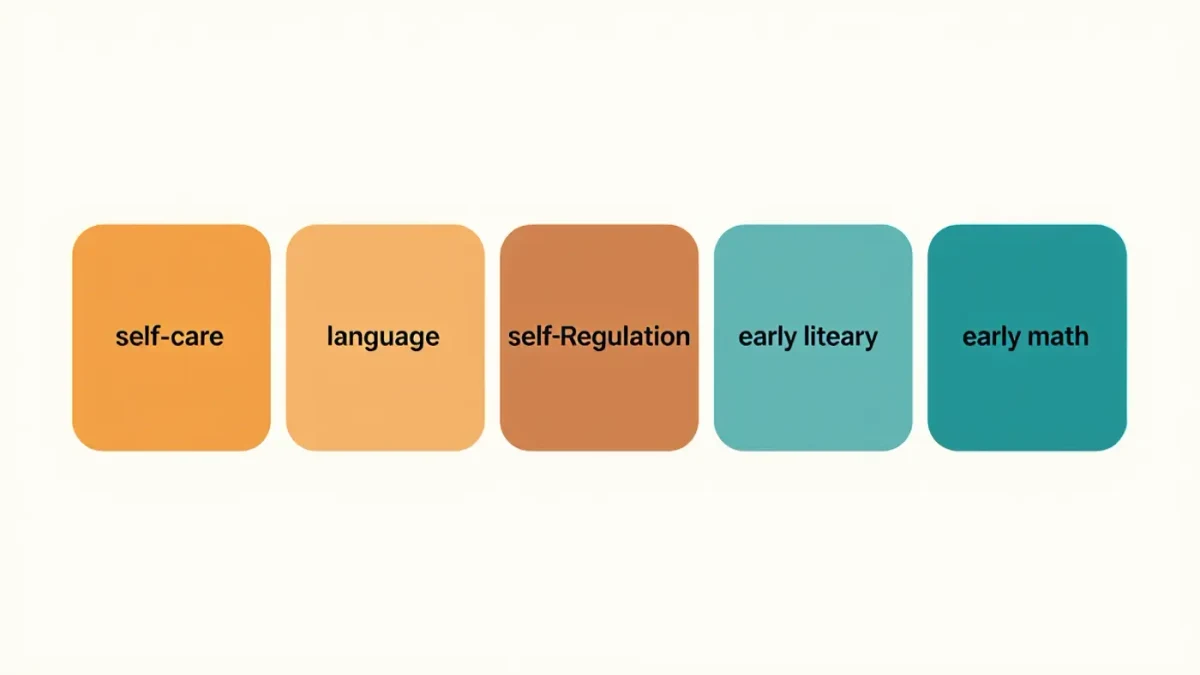
Kindergarten readiness means self-care, attention, language, and play skills — not letter-perfect academics — and no state requires a child to read or add before the first day. Age rules differ by state and district, with cutoff dates for turning five ranging across the country from mid-summer to the end of the calendar year, and kindergarten is not even compulsory in every state (Education Commission of the States, 2018). If that surprises you, you are in good company.
This guide publishes information, not advice about your specific child — developmental timelines vary, and your pediatrician and your district's own screening both belong in the conversation. What follows is what readiness actually consists of, and what a family can reasonably do in the months before school starts.
What skills do kindergarten teachers actually look for?
Teachers consistently point to self-regulation and independence over academics: following a two-step direction, sitting for a short group time, taking turns, managing bathroom needs, and separating from a caregiver without prolonged distress. Language matters just as much — a rising kindergartner who speaks in sentences, asks questions, and tells a simple story about their day is doing serious readiness work.
Early literacy shows up as interest, not mastery: noticing letters in their own name, rhyming play, asking to be read to. Early math shows up as counting objects at snack time or sorting socks by color. The Centers for Disease Control and Prevention's child development resources describe these as typical five-year-old skills, not prerequisites — and that distinction is the whole point.
Is my child old enough, and should we wait a year?
Check your district's cutoff date first, because it decides the legal answer. The judgment call is whether a young five — a child with a birthday weeks before the cutoff — would do better starting or waiting. Research on delayed entry, often called academic redshirting, finds mixed results: small early advantages that tend to fade, alongside tradeoffs for the class as a whole. There is no evidence that a child who is developmentally on track gains an edge from an extra preschool year.
If you are weighing the choice, ask the preschool teacher what they see in group settings, and ask whether your district screens incoming kindergartners. Most states use some form of kindergarten entry assessment within the first weeks of school, which means the school will meet your child where they are, with data, whether or not you worry in advance.
How do I build readiness without turning my home into a classroom?
You build it in the ordinary week. Read aloud daily and let the child turn the pages and predict what happens next — that single habit is the best-documented readiness activity there is. Narrate errands, count stairs, compare bigger and smaller, and let your child practice asking a librarian or cashier a question while you stand nearby.
- Practice the mechanics of school: opening lunch containers, zipping a backpack, wiping a table.
- Arrange short separations with familiar adults if your child has rarely been apart from you.
- Follow two-step directions as a game — "find your shoes, then put them by the door."
- Talk about school with specific warmth: the sandbox, the library corner, the teacher's name once you know it.
What does a kindergarten day actually ask of a child?
Picture the shape of the day, because readiness is mostly about that shape. A typical kindergarten morning asks a five-year-old to sit for short group lessons, move between activities with some independence, eat in a loud cafeteria, manage clothes and bathroom without help, and recover from small frustrations — a lost crayon, a turn that went to someone else — without a meltdown that eats the afternoon. None of that is academic, and all of it is learnable at home in ordinary weeks.
You can rehearse the specific asks: eating from an opened lunchbox in twenty minutes, walking in a line, raising a hand to speak, listening to a story without interrupting. Build stamina gently with longer sit-down activities like puzzles or board games. And practice the goodbye — short, warm, consistent — because drop-off is the first skill kindergarten grades, every single morning.
What if my child has a delay or an IEP already?
If your child receives preschool special education services, the transition to kindergarten is a formal process, and it starts in the spring before entry — the preschool team, the district, and you write the plan for services that continue in kindergarten. Reach the district's special education office early rather than waiting for a fall scramble, and ask what kindergarten looks like for children with the same services.
If you have concerns but no diagnosis, that early period is exactly when a screening is useful. The American Academy of Pediatrics recommends developmental screening at the 4- and 5-year checkups (2016 guidance), and your district's screening is free whether or not you are enrolled yet.
Which worries are normal — and which are worth acting on?
Normal: messy letters, reversed numbers, shyness in new settings, tears at drop-off for the first few weeks. Children arrive in kindergarten speaking hundreds of words a minute and barely any of them in the same accent of readiness, and teachers expect exactly that range.
Worth acting on: speech that is very hard for strangers to understand, no interest in stories or pictures, inability to separate after weeks of trying, or struggles with basic two-step directions. In those cases, ask your pediatrician and the district for a screening — evaluating is not failing, and services work best early.
What should we do the summer before kindergarten?
Keep the rhythm simple. Move bedtime toward the school-year schedule in the last weeks of August, visit the playground or the front door of the school so the building is a place and not an idea, and read books about starting school without promising it will be perfect. Buy shoes your child can fasten and a lunchbox your child can open.
Then say the true thing out loud: teachers like questions, nobody has to know everything, and you will be there at the end of the day. A child who walks in expecting to be liked and helped is ready, whatever the checklist says — and so are you.