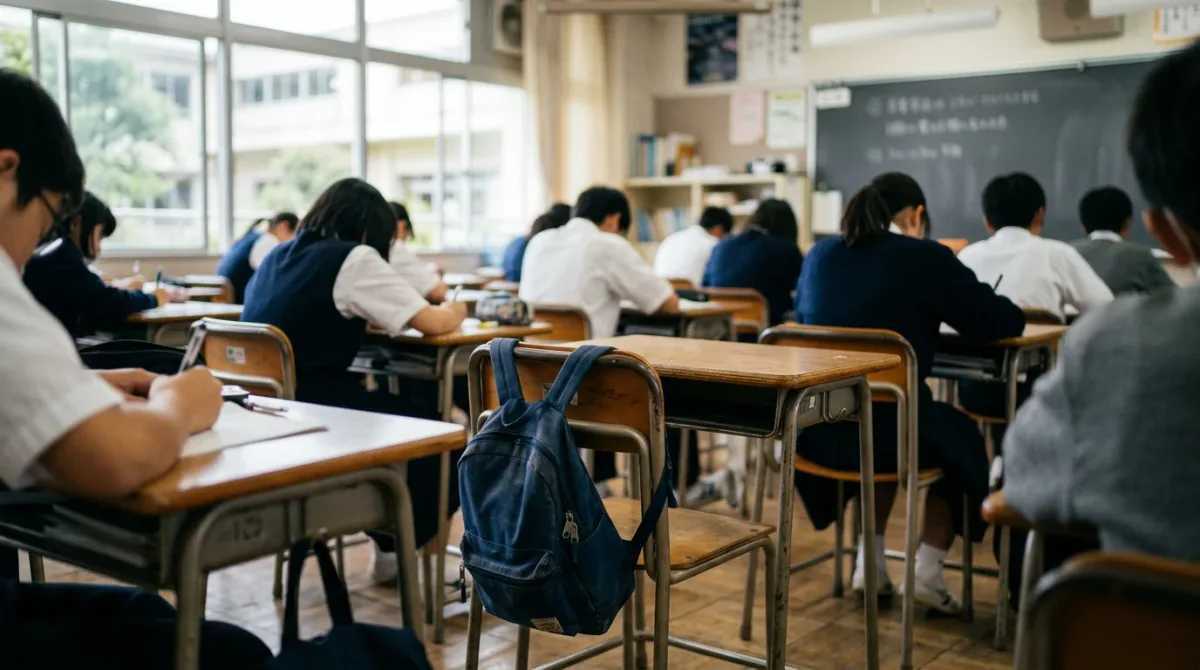
Chronic absenteeism means missing 10 percent or more of the school year — about 18 days — for any reason, excused or unexcused. In the 2022-23 school year, roughly 28 percent of U.S. students met that threshold, according to the U.S. Department of Education, down from 31 percent the year before but still far above pre-pandemic levels.
What Counts as Chronic Absenteeism?
The federal definition is simple and it does not care why a student was out. A sick week, a family emergency, a suspension, and a string of "just didn't feel like it" mornings all count the same way once they add up to about 18 missed days in a year — roughly two days a month. That math surprises a lot of parents, because it rarely feels like a pattern from the inside. A cold here, a late start there, and a family can cross the threshold without ever deciding to.
The distinction schools care about is chronic versus truant. Truancy usually refers to unexcused absences and can trigger legal notices. Chronic absenteeism is broader and is treated as an early-warning number, not a discipline category — it is meant to flag which students need support, not punishment.
How Many Students Are Missing This Much School?
The U.S. Department of Education's most recent national count, for 2022-23, put chronic absenteeism at 28 percent of students, an improvement from 31 percent the prior year but still well above the roughly 15 percent rate common before the pandemic. Twenty states reported that more than 30 percent of their students missed at least three weeks of school that year.
The strain shows up school by school. On average, an elementary school had about 88 chronically absent students, a middle school about 113, and a high school about 139, the department's data shows. In schools where at least three-quarters of students qualify for free or reduced-price meals, 58 percent experienced extreme levels of chronic absence — more than double the 25 percent rate those same high-poverty schools saw in 2017-18. Native American, Pacific Islander, Black, and Hispanic students, along with students with disabilities and English learners, continue to be absent at disproportionately higher rates, though the department notes some of those gaps narrowed slightly as overall numbers improved.
Does Missing This Much School Actually Hurt Learning?
The link between attendance and achievement shows up clearly in federal testing data. A National Center for Education Statistics analysis compared attendance and scores on the National Assessment of Educational Progress, the nation's main academic benchmark, across 2019 and 2022. In 2022, 22 percent of fourth-graders reported being absent five or more days in the prior month — roughly double the 2019 rate — and nearly three-quarters of public schools reported that chronic absenteeism had increased since before the pandemic.
Statistically, rising absenteeism was associated with a meaningful share of the era's score declines: NCES researchers estimated it accounted for about 45 percent of the drop in fourth-grade reading scores and 27 percent of the drop in fourth-grade math scores between 2019 and 2022, with smaller but still notable shares at eighth grade. The researchers were careful to call this an observed association, not proof that absences alone caused the declines — but the pattern held up even after accounting for race, income, English-learner status, and disability status. Separately, the Department of Education has found that children who are chronically absent between preschool and second grade are significantly less likely to read on grade level by third grade, and that chronically absent students are about four times more likely not to graduate high school.
Why Are So Many Kids Missing School?
The reasons rarely match the assumptions adults make. When Hudson City School District, a roughly 1,600-student district south of Albany, New York, surveyed families and held one-on-one conversations to understand its own attendance numbers, staff found causes that had little to do with motivation: some families believed rainy weather itself could make a child sick, others were unclear on bus routes, and some were walking long distances in bad weather because they lacked transportation, Education Week reported in June 2025. "Be very wary of the unverified assumptions about what's going on," Principal Mark Brenneman told the publication, describing what direct conversations with families revealed.
The Department of Education points to similar broad categories nationally: disengagement from school, gaps in family and student support services, and health challenges within the family. None of those are fixed by a stricter tardy policy alone, which is part of why schools that make real progress tend to combine several approaches at once rather than relying on warning letters.
What Can a Family Do Once Attendance Starts Slipping?
A few missed days rarely feels urgent in the moment, which is exactly why it is worth tracking before it becomes a pattern.
- Count the actual days. Ask the school for a year-to-date attendance total rather than relying on memory — most district portals show it, and the 18-day threshold is easy to cross without noticing.
- Separate the causes. Illness, transportation, and disengagement call for different fixes; naming which one is driving the absences is the first real step.
- Ask what the school can flex. Hudson City addressed transportation gaps by partnering with community organizations for backup rides and moved evening events like concerts to afternoons so they stopped causing next-day absences, according to Education Week's reporting.
- Loop in the school before it escalates. Districts that reduced absenteeism used direct, judgment-free conversations with families — sometimes called family success plans — rather than automated notices.
- Get clear on sick-day guidance. A short list of symptoms that do and don't require staying home, shared by the school nurse, prevents both over- and under-reporting of illness absences.
When Is It Time to Ask the School for Help Directly?
Waiting for a formal notice is not necessary and often means the pattern has already run for months. If a student has missed close to two days a month at any point in the year, that is the moment to ask a teacher, counselor, or attendance staff member what support exists — not after the year-end letter arrives. Hudson City's own experiment showed a 12-percentage-point drop in chronic absenteeism by early June after the district shifted from automated warnings to direct family conversations, Education Week reported.
None of this requires a family to solve a systemic problem on their own. The data shows attendance gaps closing fastest where schools and families work from the same information rather than different assumptions about what is really going on.
For a related business news perspective, read What Parents Should Know About Teen Work-Hour Rules.