Choosing a preschool comes down to three things you can actually judge on a tour: how teachers talk to children, what the daily schedule protects, and whether the program fits your family's hours and budget. Licensing rules differ by state, so a licensed program is the floor, not the seal of quality. Head Start alone served more than 800,000 children through its programs in a recent federal year (U.S. Department of Health and Human Services, 2024), and the wider market of private, district, and faith-based preschools is far larger and far less standardized.
This guide publishes information, not enrollment advice — the right setting depends on your child, your district, and your budget. What it can do is give you a set of questions that works in any program, so you leave each tour with comparable answers instead of a general good feeling.
What should I notice in the first five minutes of a tour?
Watch how adults and children interact, because that relationship is the engine of a good preschool. Listen for teachers getting down to eye level, narrating what children are doing, and answering the same question for the fourth time without irritation. Notice whether children move freely between activities or sit for long stretches waiting for instructions.
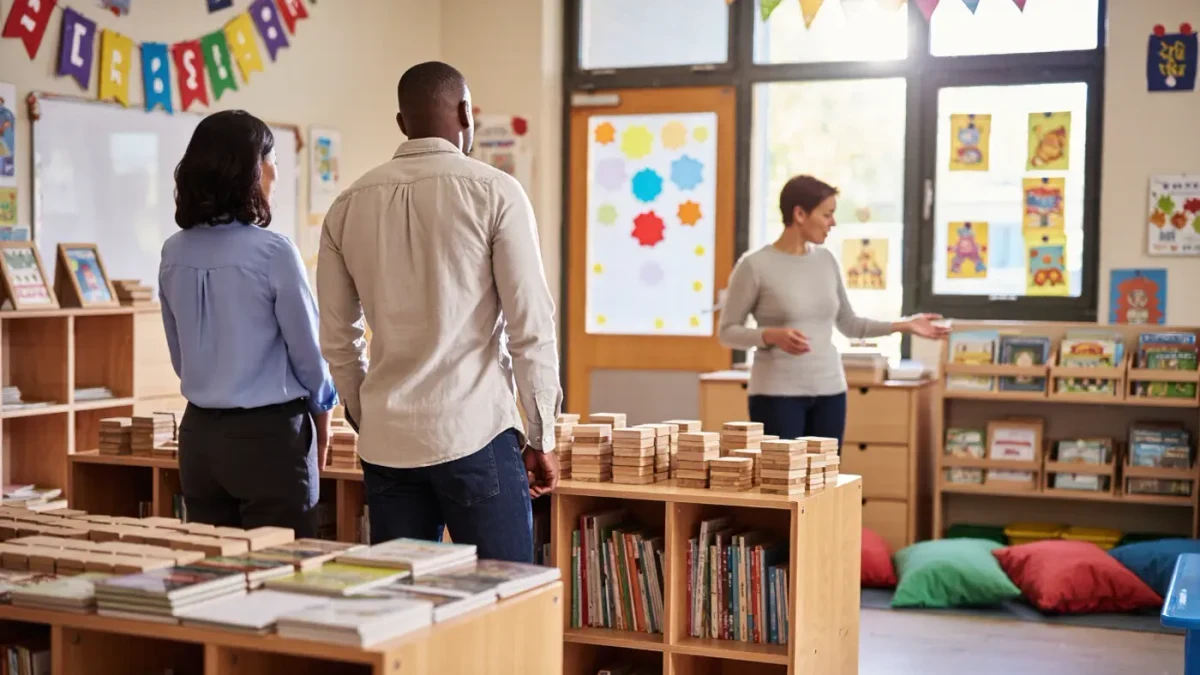
Look at the room itself. You want to see labeled shelves, a reading corner with worn books, and evidence of recent child work on the walls at child height — paintings, block structures photographed, seedlings by the window. A room that looks like a catalog but shows no trace of the children in it tells you something. So does a room where the art on every wall is identical, which usually means the adults did the project.
Which questions reveal how the program actually teaches?
Ask how the program handles play versus academics, and listen for a both-and answer rather than either-or. Research on early learning, summarized by the National Institute for Early Education Research in its annual yearbooks, consistently points to play-based instruction with intentional teaching behind it — teachers embedding letters, counting, and vocabulary into blocks, pretend play, and conversation rather than drilling them at tables.
- Ask: "What does a teacher do when a child is struggling to share?" You want calm, specific strategies, not a philosophy lecture.
- Ask how much of the day children choose their own activity. A long free-choice block is a feature, not a gap.
- Ask what the class reads aloud this month and why. Teachers who can name books and reasons are paying attention.
How do I judge safety without alienating the director?
Safety questions are normal, and any director who bristles at them is answering you anyway. Ask about staffing ratios and group sizes and compare them with your state's licensing requirements. Ask how staff are screened at hiring and how the program handles pickup by someone new.
Walk the physical space the way a three-year-old would: gates on stairs, blind spots supervised, cleaning supplies stored away, an outdoor play area with fall-safe surfacing under climbing equipment. Ask about the program's illness policy and how it communicates injuries — a program that says injuries never happens is the one to worry about.
What should I ask about the daily schedule and food?
Ask for a written copy of a typical day. A healthy preschool rhythm alternates active and quiet blocks, includes outdoor time in most weather, and builds in unhurried meals and rest. If meals are served, ask whether the program participates in the Child and Adult Care Food Program, the federal program that sets nutrition standards for meals in many preschools (USDA Food and Nutrition Service).
| Tour question | Good sign | Caution sign |
|---|---|---|
| Can I see a typical day? | Written schedule, flexible on paper | "It depends on the day" |
| What is the ratio in this room? | Stated plainly, meets or beats state rules | Numbers that shift during the tour |
| How do you handle conflict? | Concrete steps, teaching language | "We don't have problems here" |
| What does turnover look like? | Several staff past five years | Mostly first-year staff, vague answer |
How do teacher qualifications and turnover compare?
Teacher stability matters as much as credentials, because a preschooler's attachment to a familiar adult is what makes the year work. Ask how long the lead and assistant teachers have been there and what the program does to keep them — pay, planning time, and benefits show up as lower turnover. Ask whether lead teachers hold a Child Development Associate credential or a degree in early childhood education, and treat ongoing training as a plus rather than a checkbox.
You are allowed to ask who will be in the room on the days your child attends. Programs that can name the people tend to be programs where the people stay.
Should my child come on the tour?
Usually yes, for at least one visit, and with a job. A preschooler who is given one thing to check — the sand table, the doll corner, the slide — pays closer attention than one who is carried through on a hip. Watch how staff greet your child, not just you: the program's answer to a shy three-year-old at the door tells you more than any brochure paragraph about warmth.
Some families prefer a first visit alone so they can ask blunt questions about money and behavior policy without small ears in the room, then a second visit with the child. Both orders work. What you want to avoid is deciding entirely without your child ever seeing the place, because a program that reads well on paper and feels wrong to your child at the door is still the wrong program.
How do I compare costs, hours, and the waitlist?
Ask for the full price in writing: tuition, registration, supplies, meal fees, and what happens when the program closes for holidays or weather, since private preschools often follow their own calendars rather than the district's. If you earn within the income limits, ask about your state's pre-K program, Head Start, or child care subsidy — publicly funded seats are free or sliding-scale, though waitlists are common.
Before you leave, ask two closing questions: how the waitlist is ordered and whether a deposit is refundable. Then, the same evening, write down three things you saw and one thing you did not like. Notes made the night of the tour beat any brochure.
Finally, trust the fit test. The best program on paper is one where your child could picture building something, and where you would feel comfortable asking a question at pickup. Tour two or three programs with the same questions, and the comparison will do most of the deciding for you.